
Biblical marriage is based on a conception founded on the very creation of man and woman. Drawn from the same primordial individual before being differentiated in their animality, their coming together re-establishes this unity in the blending of two lives into one. This principle underpins a marriage that is both spiritually and bodily fruitful, and makes this union part of the fulfilment of God’s design for the world.
1 The original principles of biblical marriage
1.1 The creation of man ‘male and female’
When we want to go back to the origin of things, as Christians faithful to Scripture we first look at the book of Genesis. Here, the biblical foundations of marriage are implicitly laid through the very creation of man and woman, and first and foremost in the divine intention that presided over this creation:
27 God created man in His own image; in the image of God He created him; male and female He created them.
28 Then God blessed them, and God said to them, “Be fruitful and multiply; fill the earth and subdue it; have dominion over the fish of the sea, over the birds of the air, and over every living thing that moves on the earth.”Genesis 1:26-27
If ‘man’, in the singular and in a generic sense, is created in the image of God (see Man, a creature in the image of God), it is ‘man and woman’ who are created, literally ‘male and female’. We must therefore understand that man and woman together are the creation of man in the image of God, whose intrinsic multiplicity we have already emphasised, as manifested in the revelation of the Trinity (see The Triune God).
1.2 The creation of woman from man
When the complementary account of the creation of the human being is given in chronological form, we see that man (male) is created first by God from the elements of the earth, and woman (female) is created by God from the first individual :
7 And the Lord God formed man of the dust of the ground, and breathed into his nostrils the breath of life; and man became a living being. […]
21 The Lord God caused a deep sleep to fall on Adam, and he slept; and He took one of his ribs, and closed up the flesh in its place.
22 Then the rib which the Lord God had taken from man He made into a woman, and He brought her to the man.
23 And Adam said:
“This is now bone of my bones
And flesh of my flesh;
She shall be called Woman,
Because she was taken out of Man.”Genesis 2:7, 21-23
So the first man and the first woman, who in principle make up the creation of man ‘male and female’, are not created separately, but are drawn from the same primordial man, who is both the male and the one from whom they both come. This common physical origin of Adam and Eve serves as a paradigm for the biblical conception of marriage.

1.3 The differentiation of man and woman
The rest of the Genesis text shows us clearly that man and woman, Adam and Eve, are two distinct human beings, each with his or her own personality, will and body. This is the very reason for the creation of the woman, to have given Adam a similitude which is also another, essentially a female as for the other animals, as it is based on the following observation:
18 The Lord God said, “It is not good that man should be alone; I will make him a helper comparable to him.”
19 Out of the ground the Lord God had formed every beast of the field and every bird of the air, and He brought them to Adam to see what he would call them. And whatever Adam called each living creature, that was its name.
20 So Adam gave names to all cattle, to the birds of the air, and to every beast of the field. But for Adam there was not found a helper comparable to him.Genesis, Chapter 2, verses 18-20
Thus, the fertile ‘division’ of man into male and female reflects both the intrinsic multiplicity found in God himself, and man’s animality, through which he is commanded to multiply and fill the earth in order to subdue it (Genesis 1,26-27).
1.4 The union of two lives into one
However, in this differentiation of persons and roles in the first ‘mission’ entrusted to humanity, it is in the union of two lives into one that God brings together the man and woman he created:
24 Therefore a man shall leave his father and mother and be joined to his wife, and they shall become one flesh.
25 And they were both naked, the man and his wife, and were not ashamed.Genesis 2, 24-25
‘Flesh’ here does not have a pejorative meaning, but refers to the life of each person, in its animality and natural fragility: while the woman has been distinguished from the man, she is nevertheless identified with him in humanity in that she has been drawn from him. She is therefore quite literally an ‘other himself’, and the unity from which they are born is destined to be reformed by the voluntary reunion of their two lives into a single one. This original union, which serves as a model, is the very foundation of the biblical conception of marriage, and is expressed on the corporeal level by the union of the flesh, which in principle possesses its own fecundity, useful to the cultural vocation entrusted by God to humanity.
In Scripture, the differentiation and sexual union of marriage thus have as much an animal and cultural dimension as a spiritual one.
2 The purpose of biblical marriage
2.1 Finding a complement on earth
If man and woman are created in the image of God, they both reflect something of the divinity, in their common humanity and in their sexual specificity. Neither of them therefore concentrates this image exclusively, or primarily, and they are therefore each, in principle, an inalienable complement to the other. This does not mean that human individuals are in themselves incomplete, nor that a celibate life is incomplete, but that an exclusively masculine or exclusively feminine humanity would be. Indeed, while woman is taken from man, man is born of woman, as the apostle points out with regard to questions of authority in the Church:
8 For man is not from woman, but woman from man.
9 Nor was man created for the woman, but woman for the man.
11 Nevertheless, neither is man independent of woman, nor woman independent of man, in the Lord.
12 For as woman came from man, even so man also comes through woman; but all things are from God.1st Epistle to the Corinthians, Chapter 11, verses 8-12
2.2 The wife as the man’s helper
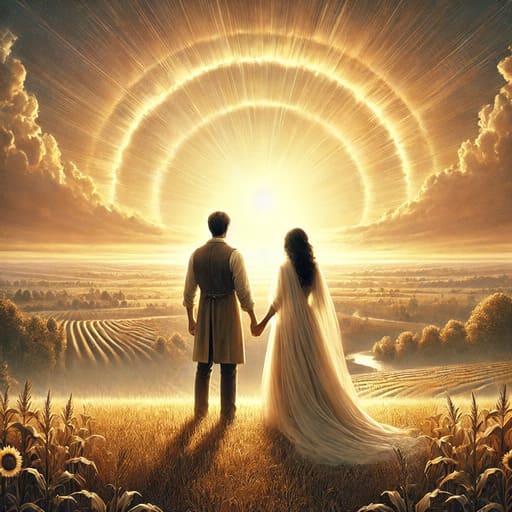
In terms of marriage, i.e. the union of two lives into one flesh, Moses, the presumed author of the book of Genesis, sees the creation of the woman as that of a ‘helper’ or ‘help’ similar to the man (Genesis 2:18). The same expression, ‘helper’ or ‘help’, is used elsewhere about God in relation to ancient Israel in Psalm 46 (v2), and therefore does not reduce woman to a subordinate.
But this creation of woman serves as a paradigm for the human condition: ‘A man shall leave his father and mother and be united to his wife, and they shall become one flesh’ (Genesis 2:24). This is not a commandment, but a universal principle: human beings grow up dependent on their parents, whom they must leave one day to lead their own lives.
By its very nature, then, it aspires to re-form a fruitful unity with another human being, a complement of the opposite sex. This powerful sexual instinct reflects the primordial unity of Adam, from which the original man and woman were drawn, and to which they returned in their animality in order to populate the earth. This earth is the very matrix of their existence, which God has given them as an inheritance as their environment and as the world in which they must reign in a benevolent and peaceful manner.
2.3 The biblical conception of marriage
The biblical concept of marriage is therefore based on the creation of man and woman in the image of God, Eve having been taken from Adam to be the mother of all the living. The biblical purpose of marriage, then, is the covenant, the union of two human beings, each distinctly bearing the image of God in two different sexes, to lead a creative and fruitful life together on the Earth.
Thus, since the Mosaic principle relates to the union of man and woman in one flesh as an end in itself, procreation does not appear as the ultimate end of marriage, but rather as a consequence of the union of the flesh, as the fruit of a fertile sexual relationship that is the bodily expression of the union of two lives. This union as an end in itself is, moreover, interpreted by the apostle Paul as prefiguring the union of Christ and the Church:
29 No one ever hated his own flesh, but nourishes and cherishes it, just as the Lord does the church.
30 For we are members of His body, of His flesh and of His bones.
31 “For this reason a man shall leave his father and mother and be joined to his wife, and the two shall become one flesh.”
32 This is a great mystery, but I speak concerning Christ and the church.Epistle to the Ephesians, Chapter 5, verses 29 to 32
We can see, however, that the principle of marriage serves, through the powerful sexual instincts of man and woman which it is impossible to ignore, God’s purpose in creating man ‘male and female’. This purpose is expressed in the prophetic blessing to ‘multiply and fill the earth, that you may have dominion over it’ (Gen 1:28), in the image of God who reigns over the cosmos and has given the earth to humanity. The purpose of biblical marriage is therefore at once relational, spiritual and cultural: it aims to fill the solitude of the man or woman who feels, in his or her flesh, the need for another self, to fulfil God’s plan for humanity on earth, and to establish man’s presence in the world through his ability to transform it.
Conclusion
Marriage, as presented in Scripture, is not a mere human arrangement dictated by social or cultural considerations, but is rooted in the very order of creation. It reveals a fundamental structure of humanity, in which man and woman, while distinct, are called to unite in order to reflect the image of God in their complementarity. This union, intended from the beginning, paves the way for the ultimate understanding of Christian marriage, which is based on a mutual commitment in faith and on the integration of this relationship into the dimension of the Church.
The distinction between man and woman, inscribed in a unity that transcends it, reflects the mystery of unity and diversity in God. Just as the divinity is one and yet distinguished in three persons, marriage manifests a unity that does not dissolve into total indistinction, but is fulfilled in a living and dynamic relationship. Man and woman, having become one flesh, retain their own identity in a new reality. By this analogy, human marriage prepares us to understand the ultimate bond between Christ and his Church, which will find its fulfilment in the accomplishment of God’s plan.
0 Comments