
We propose here a classical theological interpretation of the nature of the knowledge of good and evil associated with Adam and Eve’s departure from the Garden of Eden, in the spirit of philosophical theology.
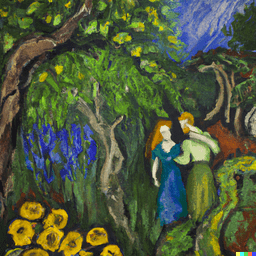
1. Setting the scene: the tree of the knowledge of good and evil
1.1. The two trees in the Garden of Eden
In chapter 2 of Genesis, we read about the planting of the Garden of Eden and the two mysterious trees:
Then the Lord God planted a garden in Eden on the east side, and there he put the man he had formed. And out of the ground the Lord God made to grow every tree that is pleasant to the sight and good for food, and the tree of life in the midst of the garden, and the tree of the knowledge of good and evil.
Genesis, Chapter 2, verses 8 and 9
The knowledge in question is therefore ethical or moral knowledge, the knowledge of good and evil. Note the originality of the biblical conception compared with the usual cosmogonic accounts (about the origin of the world and of man).
1.2. The tree of the knowledge of good and evil and death
This knowledge is presented here as the major spiritual challenge of human existence. By this I mean that eating of the fruit of this tree is presented as punishable by the worst punishment, death, as we read in the same chapter:
And the Lord God commanded the man, saying, Of every tree of the garden thou mayest eat: but of the tree of the knowledge of good and evil thou shalt not eat of it: for in the day that thou eatest thereof thou shalt surely die.
Genesis, Chapter 2, verses 16 and 17
2. What is this knowledge of good and evil?
2.1. The nature of the knowledge of good and evil
Here we need to understand, i.e. interpret, what this knowledge might consist of. Let us continue to examine the text of Genesis. A clue is given to us at the end of chapter 3, when Adam and Eve have disobeyed, and the “promised” punishment is applied:
The Lord God said: Behold, the man has become like one of us in the knowledge of good and evil. Let us now prevent him from putting forth his hand, and taking of the tree of life, and eating thereof, and living for ever.
Genesis, Chapter 3, verse 22
So what man is guilty of here is “becoming like God” in this knowledge. In other words, it is not necessarily a question of having acquired a knowledge of good and evil by eating forbidden fruit, but of having risen to the stature of God with regard to this knowledge.
2.2. Adam and Eve knew good and evil
In fact, in the Old Testament, the whole question of the Law given to the people of Israel concerns this distinction between good and evil, and the knowledge of good and evil comes from a revelation of the divine will. There is no reason to think otherwise here; the text seems to me to present Adam and Eve as already knowing good and evil, in other words the will of God, revealed here through the single commandment of Gen 2:16-17.
3. What would the transgression of the commandment consist of?
3.1. The nature of the original transgression
According to this understanding, namely that Adam and Eve were in possession of the essential knowledge of good and evil, i.e. of the divine will, in what way would they then have “become like one of us in the knowledge of good and evil”? This text shows the “Eternal God”, the deity of ancient Israel, as the supreme lawgiver who is depicted in the rest of the Pentateuch (the first five books of the Bible). In other words, God’s relationship to the knowledge of good and evil is to be the source of it, since in his will lies the standard of what is good and what is evil.
3.2. The affirmation of spiritual and moral independence
So the punishment attributed to Adam and Eve in this text relates to their affirmation of their moral, and therefore spiritual, independence. Having a knowledge of good and evil through the revelation of the divine will expressed by the commandment, we see them transforming their autonomy into independence, by disobeying the commandment. In so doing, they reject the knowledge of good and evil given by revelation, and set themselves up as their own spiritual, ethical and moral standard, thus becoming “like God in the knowledge of good and evil”.
4. Did eating the fruit provide knowledge of good and evil?
4.1. The serpent’s promise
In chapter 3 we read:
“Then said the serpent unto the woman, Ye shall not surely die: but God knoweth that in the day ye eat thereof, your eyes shall be opened, and ye shall be as gods, knowing good and evil.”
Genesis, Chapter 3, verses 4 and 5
We are not talking here about the affirmation of God, who gave the commandment, but of the serpent, who is looking for a tortuous (!) way around it, by proposing his own interpretation. It is precisely by dangling false knowledge in front of Eve and Adam that he succeeds in leading them to transgression.
4.2 The tree as a symbol
So, if our first parents had the knowledge of good and evil in the revealed will of God, the tree from which it was forbidden to eat did not in itself possess the virtue of giving superior knowledge (how, moreover, could eating the fruit of a tree bring moral knowledge?), but it was the very object through which this knowledge was to be put to the test, in the environment of the Garden of Eden where God had placed man. For man and woman, created in the image of God, had to be confronted in their freedom with a choice: that of voluntarily accepting the knowledge of God as he made himself known to them, or on the contrary of rejecting him in order to proclaim their independence. And this tree, the very object of God’s commandment, was the symbol “incarnating” this knowledge of Good and Evil.
4.3. The fruit of transgression
This reading fits in well with the account of the punishment already mentioned (Gen 3:22), where it is possible to see here a form of irony when God considers that “man has become like one of us in the knowledge of good and evil…”. This was the serpent’s promise, but it was not fulfilled as he intended. Moreover, when Adam and Eve had consumed the fruit of their transgression, we read in chapter 3 that they covered their nakedness and “hid themselves from God”. The fruit of their transgression is not presented here as an increase in their knowledge, but rather as a form of confusion and an alienation of their spiritual and moral intelligence. And this confirms that moral knowledge lay elsewhere, and that the serpent’s “magical” proposal was an invention.
5. The knowledge of God and eternal life
5.1. The tree of life
Alongside the tree of the knowledge of good and evil, another tree was planted, called “the tree of life” (Genesis 2:9, op. cit.). This mysterious tree also possessed a profound and essential meaning, since, as we have already noted, in relation to it Adam and Eve’s transgression deprived them of eternal life:
The Lord God said: Behold, the man has become like one of us in the knowledge of good and evil. Let us now prevent him from putting forth his hand, and taking of the tree of life, and eating thereof, and living for ever.
Genesis, Chapter 3, verse 22
We see here that man wanted to rise to the level of God as a moral legislator, so the Lord drove him out of the garden. The rhythm of the sentence implies that by preventing man from eating the fruit of this tree, the Creator wanted to prevent him from gaining access to eternal life: we infer from this that the gift of eternal life resided precisely in eating this fruit, and that the enjoyment of this gift was conditional on observing God’s commandment. So Adam and Eve had to abstain from eating of the fruit of the tree of the knowledge of good and evil, in order to be able to eat of the fruit of the tree of life and live forever.
5.2. The principle of eternal life
If we are talking here about eternal life, i.e. the perpetual regeneration of the body, it is conceivable that a particular food can confer immortality, as an additional gift to natural or animal life. For this original vocation of man is a reflection of his spirituality: created in the image of God, he is called like God to an eternal existence, and the Christian hope of the resurrection proclaims no different. However, eternal life as a gift of the perpetual life of the body can only be the expression of a spiritual life, which is its true principle, and whose essence is the very knowledge of God. In any case, this is how Christ sees it in the Gospel according to John:
And when Jesus had spoken these things, he lifted up his eyes to heaven, and said, Father, the hour is come. Glorify your Son, that your Son may glorify you; for you have given him authority over all flesh, that he may grant eternal life to all whom you have given him. And eternal life is that they should know you, the only true God, and him whom you have sent, Jesus Christ.
Gospel according to John, Chapter 17, verses 1-3
5.3. Knowing God for eternal life
According to our reading of the first three chapters of Genesis, this principle was at work from the beginning of the world, since through the test of obedience to God’s command, Adam and Eve were ultimately confronted with the knowledge of God. For God makes himself known through what he reveals to man of his being and his will, and the apostle Paul teaches in the epistle to the Romans that all men know the divinity in their conscience and through his works:
The wrath of God is revealed from heaven against all ungodliness and unrighteousness of men who unjustly hold the truth captive, for what can be known of God is manifest to them, God having made it known to them. For the invisible perfections of God, his eternal power and divinity, have been visible to the eye since the creation of the world, when they are seen in his works. [When the Gentiles, who have no law, naturally do what the law prescribes, they, who have no law, are a law to themselves; they show that the work of the law is written in their hearts, their conscience bearing witness to it, and their thoughts alternately accusing and defending themselves.
Epistle to the Romans, Chapter 1, verses 18-20 and Chapter 2, verses 14-15
Having this inner and universal knowledge of God and his will within themselves, Adam and Eve had also received the revelation of God’s will in the form of an explicit commandment. Through this, they were called to manifest their knowledge of God by their obedience, so that their spirituality would be confirmed by the gift of eternal life. It was this gift that they denied themselves, wanting to “become like God in the knowledge of Good and Evil”, and it is the gift that Christ offers again to everyone who believes in him “that they may not perish but have eternal life” (John 3:16).
Morality
This story of the first pair of human beings committing an original sin can serve as a paradigm for the human condition. The man of the Bible possesses an autonomy in which he is confronted with the revelation of the divine will, and in general with the revelation of God himself. As a conscious and free being, he has the capacity to act on this knowledge by receiving it as such, in order to enter by faith into the eternal life of which it is the principle, or to affirm his independence and therefore his own “divinity”.
0 Comments