
The question is intentionally provocative: it all depends on what one means by “Christian.” For me, a Christian is someone who believes in Christ. However, from the perspective of historical Protestantism, which is where I stand, being a Christian means believing in Christ as He is presented in Scripture. After many years of in-depth and engaging discussions with Jehovah’s Witnesses, I recently identified what seems to me to be the fundamental issue with their doctrine and, consequently, their religion.
The question of compatibility between the Christian faith and the religion of Jehovah’s Witnesses undoubtedly arises primarily on an individual level. It is important to emphasize that no theological reasoning alone can determine a person’s spiritual status. However, my aim here is to examine, from a strictly theological perspective, the compatibility between Christian doctrine as revealed in the Bible and the teachings of the Jehovah’s Witnesses organization.
1. The Problem of Evil and the Hope of Healing
From a historical Protestant perspective, there are numerous disagreements with Jehovah’s Witnesses regarding their interpretation of Scripture, particularly on fundamental doctrines such as the Trinity, the Incarnation, the Holy Spirit, and the Last Judgment. However, it is through the problem of evil and suffering that I have identified what seems to me to be the central flaw in their theological approach.
Emblematic Example: The Translation of the Name “Jehovah”
A striking example of their interpretative method is found in their New World Translation. This version systematically translates the Greek term kurios (κύριος) as “Jehovah” when it is intended to reflect the Hebrew term adonai (אדונאי), used in the Old Testament in place of the Tetragrammaton (יהוה). Yet, “Jehovah” is a hybrid construction derived from the traditional Jewish vocalization of the Tetragrammaton with the vowels of adonai. Forcing this name into the texts of the New Testament, where it does not appear, demonstrates a highly problematic doctrinal approach.
Despite such disagreements, we share with them a common understanding of the origin of evil as tied to original sin and the Christian hope of an ultimate healing of humanity and the earth through Christ. But what, then, is the core issue with their doctrine in this regard?
2. The Cross as the Sole Solution to the Problem of Evil
Even though we share the hope of the restoration of all things in Jesus Christ with many Christian confessions or cults, it is evident that in our present existence, God does not resolve the problem of evil—even in the lives of believers. Instead, He calls us to endure, by faith, the trial He mysteriously places upon us and to cultivate hope through it. As the apostle Paul writes:
We also glory in tribulations, knowing that tribulation produces perseverance; and perseverance, character; and character, hope.
Epistle to the Romans, Chapter 5, verses 3-4, NKJV
How, then, can we accept being afflicted by evil that we did not commit, while believing and knowing that we are not directly responsible for its origin? We did not choose to be born into this world disfigured by evil and suffering, nor were we given the opportunity, like Adam, to decide before the Creator for a life and a world free from them.
Nevertheless, while we acknowledge the presence of evil in the world, we must also admit that we perpetuate it ourselves. As Paul Ricoeur highlights in Le conflit des interpretations, we are participants in evil by committing sin. Thus, even if evil afflicts us unjustly, we cannot consider ourselves innocent.
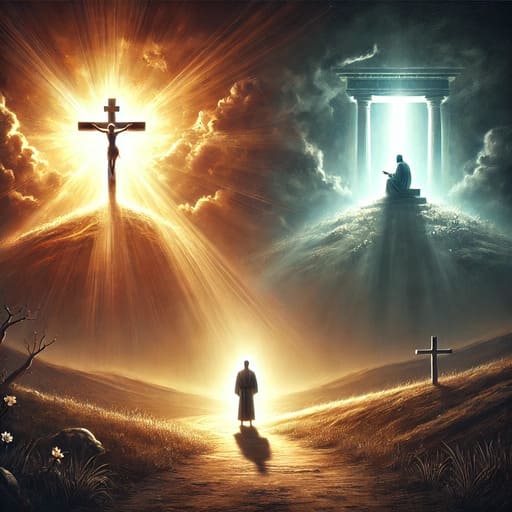
But this tension, to me, remains the ultimate trial of faith: how can I believe that God is good when evil afflicts me unjustly? The only theological solution I have found lies in the incarnation of Jesus Christ. In Him, God participated in human suffering to eradicate evil from creation through His atoning and redemptive work on the Cross. While evil is wholly foreign to His nature, God humbles Himself to share our burden and to triumph over it.
3. The Sacrifice of Jesus Christ and the Divinity of the Son
It is precisely at this point that the doctrine of Jehovah’s Witnesses fails to offer the consolation of the Cross to the authentic Christian, and this in two ways.
3.1. The Sacrifice of Christ Is Valid Only If the Son Is God
The doctrine of Jehovah’s Witnesses finds its roots in the Arianism of Antiquity, possibly influenced by a Neoplatonic background. By denying God the possibility of being both One and Many through the three persons or hypostases—the Father, the Son, and the Holy Spirit—they reject the equality of essence between the Son of God and the Father, thus betraying the mystery of the Trinity.
From this perspective, the sacrifice of Christ is not that of God Himself incarnate but that of a finite creature, however exalted it may be. This poses a fundamental problem: the reconciliation of humanity with God and the healing of the world cannot be secured by a limited sacrifice. How could the death of a mere man, even if he were “a god,” atone for the sins of the entire world unless that man were also the infinite God?
Moreover, without the Incarnation of God in Jesus Christ, the connexion between God and the world—established through creation and providence—remains irreparably broken in alienation. If God Himself has not come in the flesh, the ontological distance between the Creator and His creation remains insurmountable.
But beyond these questions concerning the Incarnation of the Son of God, Substitutionary Atonement, the Redemption of humanity, and the Restoration of creation—where the doctrine of Jehovah’s Witnesses proves problematic, if not insufficient—the denial of the essential divinity of Jesus Christ poses an insoluble problem if God Himself did not die on the Cross in His Son.
3.2. The Greatness of God Demands That the Death of Christ Be His Own
In recent times, Jehovah’s Witnesses have made an effort to align themselves with Christians on certain topics, and in this sense, they willingly emphasize the value of Jesus Christ’s sacrifice. Yet, for them, if Jesus Christ is not God Himself, it means that God sent someone other than Himself to partake in human suffering and to die in their place for their salvation.
Thus, according to their doctrine, God would have created a world where He allowed the entry of evil and the unjust suffering of His creatures without bearing the burden Himself, delegating to another the work necessary for the redemption from which we hope for healing.
However, while the atoning value of the Son of God’s sacrifice is primarily theoretical, His identification with human suffering is existential. It reaches us in our very flesh, where our faith in a good God is tested. I understand intellectually that Jesus Christ must be God for His death to have the power to atone for my sins. But in my own suffering, when I face the ultimate question in the trial of my faith—“Does God exist?” or rather, “Can God be good, given the existence of evil?”—I find consolation only in remembering that at the Cross, it was God Himself who shared in unjust suffering, even though I do not understand why He allowed it.
Jehovah’s Witnesses cannot know this consolation, for they believe that God created humanity to suffer unjustly the consequences of Adam’s sin without Himself taking part in the human condition, while sending a creature to bear in His stead the evil that brings us redemption. Such a God is one I cannot believe in, and this is the most essential reason why I could never become a Jehovah’s Witness.
Conclusion
By denying that Jesus Christ is fully God, Jehovah’s Witnesses present a distant God, incapable of fully identifying with the human condition and bearing Himself the suffering necessary for our redemption. Their vision diminishes divine greatness by refusing to acknowledge the infinite love and humility of God, who chose to reveal Himself and humble Himself in Christ.
This is why we find, in the words of the apostle Paul, the perfect expression of what consoles and convinces us:
Let this mind be in you which was also in Christ Jesus, who, being in the form of God, did not consider it robbery to be equal with God, but made Himself of no reputation, taking the form of a bondservant, and coming in the likeness of men. And being found in appearance as a man, He humbled Himself and became obedient to the point of death, even the death of the cross.
Epistle to the Philippians, Chapter 2, verses 5-8, NKJV
In Jesus Christ, it is God Himself who chose to endure suffering and death to reconcile us with Himself. The God who reveals Himself in this way alone possesses the greatness that inspires true faith, for His self-abasement in Christ testifies to a love and justice that transcend all human understanding.
0 Comments