
The Book of Genesis presents man and woman as creatures of God. Man, created male and female in the image of God, thus reflects divine unity and multiplicity. Both an animal creature and a spiritual creature, man is unique as a spiritual animal, and can only be understood theologically through these two dimensions, which articulate in him the finite and the infinite.
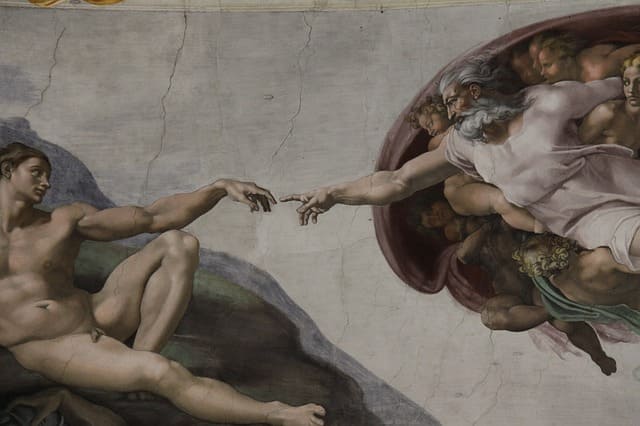
1 Finite man created in the image of the infinite God
When we spoke of God as the creator of the universe, we referred to the creation of man and woman in the account in Chapter 1 of the book of Genesis:
And God said, Let us make man in our image, after our likeness; and let them have dominion over the fish of the sea, and over the fowl of the air, and over the cattle, and over all the earth, and over every creeping thing that creepeth upon the earth. So God created man in his own image, in the image of God he created him; male and female he created them.
Genesis, Chapter 1, verses 26 and 27
Man and woman are created “in the image of God”, “according to his likeness”. There are a number of elements that need to be analysed and integrated into our theology.
1.1 Created in the image and likeness of God
Over the centuries of Christianity, theologians have debated what this “image of God” (imago dei in Latin) was and what it was not, and its relationship to the “likeness” of God, which is also discussed. Some have sought to draw a meaningful distinction between the two, but there are textual arguments in favour of a rapprochement, or even an identification, of the two ideas. Perhaps the simplest is found in Genesis Chapter 5, when the same idea is repeated in the context of the genealogy of Adam and Eve:
This is the book of the seed of Adam. When God created man, he made him in the likeness of God. And he created man and woman, and blessed them, and called their name man, when they were created. When Adam was a hundred and thirty years old, he begat a son in his own likeness, after his own image, and called his name Seth.
Genesis, Chapter 5, verses 1 to 3
In this text, the creation of man “in the image of God” is replaced by his creation “in the likeness of God”, which shows the equivalence of the two ideas. What’s more, Adam transmits this likeness to his descendants, his son being begotten this time “in his likeness” (compare “in our image”, 1:26) and “according to his image” (compare “according to our likeness”, 1:26): even the use of prepositions is switched (“in” or “to” = ב, “according to” = כ in Hebrew), which underlines that we should not see technical elements used to distinguish too much between the two.
So it seems to us that these two expressions, “in our image” and “according to our likeness”, should be understood together as saying essentially the same thing, in different and complementary ways. To put it simply, God wanted man to resemble him and to be a representation of him in the world, which is precisely what an image is.
1.2 What is the image of God?
Since “God is spirit” and therefore has no bodily nature, some have wanted to see man’s likeness to God in the spiritual dimension of his being. However, the anthropomorphisms used in Scripture to describe God’s attitudes and actions include all the dimensions of man’s being. It therefore seems to us that we must consider that the whole of man’s being is in the image of God, and that his body itself participates in this likeness:
- just as God knows all things (omniscience), so man can know certain things through the perception of the senses and the conception of the mind
- just as God is present in all things and all things “are in him” (omnipresence), man is present to certain things through his body, which he inhabits in the world and in which he inhabits the world
- just as God can act on all things (omnipotence), man can act on certain things through the intentional use of his body
- just as God exercises his will over all things, so man can exercise his will over certain things, and in particular over himself and his own instincts.
Thus, the creation of man in the image of God means, in our view, that man is a finite representation of God in the created world, where he can express by analogy the different dimensions of divine existence within the limits of a creature, within a created universe. And it is in turn because man is created in the likeness of God that by ‘inverse’ analogy he can know and understand something of God whom he resembles, even if we have to look to God for the infinite original of what we find in man, rather than conceiving of him in man’s image.
1.3 Created in the singular and plural: the finite projection of the divine one and many
If man, in the generic sense, is created in the image of God, that is to say as a finite representation of God, he is created both as an individual and as a couple. In Genesis 1:26-27 (quoted above), the divinity’s intention is to create man (in the singular) in his own image. This is how Adam, the first individual (male) of the human species, is created before Eve, as reported this time in Chapter 2 of Genesis:
And the Lord God formed man of the dust of the ground, and breathed into his nostrils the breath of life; and man became a living being.
Genesis, Chapter 2, verse 7
According to this complementary account to the account of the creation of the world (Genesis 1:1 to 2:3), it was only after man had been placed in the Garden of Eden to receive God’s first commandments (Genesis 2:8-17), and had exercised his dominion over the animal kingdom by naming the other species (Genesis 2:18-20), that the first woman was created:
Then the Lord God caused a deep sleep to fall upon the man, and he fell asleep; he took one of his ribs, and closed up the flesh in its place. Then the Lord God made a woman from the rib he had taken from the man, and brought her to the man. And the man said, “This is she who is bone of my bones and flesh of my flesh; she shall be called Woman, because she was taken from Man.
Genesis, Chapter 2, verses 21-23
The very process by which Adam discovers his loneliness is part of his realisation of his need and of God’s providence (verse 23), but the historical contingency of these two distinct acts of creation, revealed by this second account, must not obscure the affirmation found in the first account in Genesis 1:27: “God created man in his own image, in the image of God he created him; male and female he created them.” If God, who is both one and multiple (see The God who created the universe), created man (in the singular) in his own image, he also created him multiple, i.e. “male and female”, or “male and female”. Thus, the individual Adam represents both the first man, created in the image of God, and humanity in a generic sense, so that Eve, the first woman created, was also created in the image of God, because she was made from Adam. This is confirmed in the book of Adam’s genealogy when it states “And he created man and woman, and blessed them, and called their name man, when they were created” (Genesis 5:2): they are both called by the name man (“Adam”) in the singular. In short, in the creation of man, the one and multiple character of the divinity is imprinted in the image of God: the sexual differentiation of man and woman is an intentional expression of interpersonal differentiation in the sense of the divinity, and therefore has a fundamental spiritual meaning.

2 Humanity: animality and spirituality
2.1 Man’s animality
While man is created in principle “in the image of God” (Genesis 1:26-27, op. cit.), when Adam is created from the elements of the earth and God gives him life, he becomes a “living being” (Genesis 2:7, op. cit.). The Hebrew expression used (לְנֶ֥פֶשׁ חַיָּֽה) is identical to that used in Genesis 1:20-21 (נֶ֣פֶשׁ חַיָּ֑ה) and on other occasions in the Old Testament to refer to animals :
God said, Let the waters bring forth living creatures in abundance, and let birds fly upon the earth to the expanse of heaven. God created the great fish and all the living creatures that move, and the waters produced them in abundance according to their kind; he also created every winged bird according to its kind. And God saw that it was good.
Genesis, Chapter 1, verses 20-21
However, some translations of the Bible, such as the Louis Segond 1910 (revised) version used here, adopt a different translation in the two texts, preferring to speak of man as a “living being” in Genesis 2:7. But there is no justification for this distinction in the biblical text, which makes man just another animal – even if he is a very special animal, a spiritual animal. Perhaps the Christian tradition has been too keen to distinguish man from (other) animals, and to forget his authentic “animality”: this would explain the exclusive emphasis placed on the spiritual dimension of man in classical interpretations of the “image of God”. Yet Scripture speaks otherwise, even explaining that in creating man, God created him “male and female” – rather than “male and female” (Genesis 1:27). Thus, in his animality, man shares sexual differentiation with most other animals, and in general the animal condition, being of the same ‘origin’, the earth, as all the living beings that inhabit it. This unity of the animal condition and the human condition is undoubtedly evoked in the opening of the “second account” of creation, which can alternatively be translated as follows:
These are the generations of the heavens and the earth, when they were created, when the Lord God made the earth and the heavens.
Genesis, Chapter 2, verse 4
In other words, the man, animals and woman mentioned in the rest of the story are the same posterity (i.e. descendants) of the heavens and the earth. The expression “this is the seed” (אֵ֣לֶּה תֹולְדֹ֧ות) is repeated with variations in the book of Genesis, and gives structure and rhythm to it; it is found, for example, identically (וְאֵ֨לֶּה֙ תֹּולְדֹ֣ת) in Chapter 10, verse 1: “This is the posterity of the sons of Noah, Shem Ham and Japheth. Sons were born to them after the flood.” The classic translation “These are the origins of the heavens and the earth, when they were created […]” – which reverses the idea to speak of “origin” – also seems to us to reflect an unjustified bias: according to the biblical text, the universe and the earth are the family of animals and man.
2.2 The spirituality of man
If man is an animal among all the others, he is also an animal different from all the others. The episode of Eve’s creation expressly underlines this: through the task he was given of naming the other animals, Adam had to experience their knowledge, only to find that none of them resembled him:
The Lord God had formed out of the earth every beast of the field and every bird of the air, and he brought them to the man to see what he would call them, so that every living thing would bear the name that the man would give it. And the man gave names to all the cattle, and to the birds of the air, and to every beast of the field; but for the man he found no helper like himself.
Genesis, Chapter 2, verses 19-20
(Note: we translate “had formed” rather than “formed” the first verb – in wayyiqtol – of verse 20).
By assigning a name to the animals – a prerogative which here is a matter of authority, since God himself gave a name to the elements of creation in the “first account” (Genesis 1) – Adam set himself apart from them, already establishing the dominion spoken of in Genesis 1:26-27. This intellectual task implied the use of reason and speech, which distinguish man from the rest of the animal kingdom, and which serve the additional dimension he has been granted: man is a spiritual animal. Having developed an awareness of his own earthly identity, Adam was thus able to identify which other creature truly corresponded to him (Genesis 2, 21-23, op. cit.).
Man’s spirituality means that in the image that God projected when he created him, he introduced an aspect of his existence that transcends the finitude of animal life, inscribed in the manifestation of instincts limited to the present or immediate place and time. For while man, like other animals, is endowed with powerful instincts at the service of his earthly life, through his spirit, i.e. his rationality and consciousness, his thought and language, he can extricate himself from the limits of space and time. And like God, who is infinite, man in his spirituality participates in infinity, just as he participates in finitude.
To be continued…
0 Comments