Introduction
The Roman Catholic Church has consecrated Mary as the “Mother of God”, which can cause a certain amount of embarrassment from a Protestant perspective, often reluctant to attribute to Mary what is not appropriate for a “mere woman”. Have we understood the meaning of the expression correctly?
1 The doctrine of the eternal begetting of the Son of God
It was considered early on in Christian theology, and this was formalised at the First Council of Nicaea in 325, that as the Son of God, Jesus Christ was “true God of true God, begotten and not made”. In other words, the doctrine of the eternal begetting of the Son of God complemented that of his incarnation, so that Jesus Christ himself could be considered God (see The Incarnation of the Son of God).
2 The invention of “theotokos
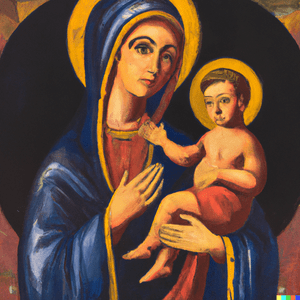
Some have deduced that if Jesus Christ truly possesses divinity, Mary, as the mother of the man Jesus, is also truly the mother of God. This title of “theotokos” (mother of God), invented the same year as the Council in 325, gave rise to a heated controversy in the 5th century, provoked by Nestorius, bishop of Constantinople: how could God have been formed in the womb of a woman?
3 The consecration of the title under the influence of Cyril
But the doctrine of the hypostatic union (union of the two natures, divine and human, in the person of the Son of God), formulated at the Council of Ephesus in 431, which deposed Nestorius, clarified the still ill-defined dogma of the dual nature of Jesus Christ. Cyril of Alexandria, Nestorius’ opponent and a major player at the Council, added to this doctrine the doctrine of the communication of idioms, according to which the properties belonging to one of the two natures of Jesus Christ apply to the other. On the basis of these ideas, the Council definitively established and consecrated the title of “theotokos” attributed to Mary in the Roman Catholic tradition.
4 What are we to make of this?
Although Cyril’s doctrine is not lacking in a certain logical coherence, it is nevertheless necessary to discern, in the communication of idioms, what comes under the dual nature (divine and human) of Christ, and what comes under his person. We must beware that if Mary begets Christ, it is the man Jesus that she begets, in other words the person of the Son of God in his incarnation. In other words, Mary did not beget the Son of God in his divinity, that is, the divine “substance” that belongs to him. That one and the same person, the Son of God, possesses in the eternity of divine life the divine nature, and in the temporality of his incarnation, the human nature, does not mean that the man Jesus Christ brought his divinity through his humanity, which would border on the confusion of the divine and human natures, the principle of the hypostatic union formulated in the same council. It therefore seems to us preferable to reject ‘theotokos’ from a Protestant perspective.
Conclusion
The dogma of the “theotokos”, which proclaimed Mary “mother of God”, stems from a desire to take seriously the hypostatic union, that is to say the union in a single person, the Son of God, of the divine nature and the human nature, since it was indeed of this person that Mary was the mother. However, the communication of idioms, the dogma on which the “theotokos” is based, introduces a regrettable confusion which suggests that it should be rejected or rethought.
0 Comments